| 1540-1640 |
The Price Revolution in Europe |
| Europe, including Britain, experiences a prolonged period of inflation, partly because
of the huge influx of gold and silver from the Spanish colonies in America and partly
because the increase in population is not matched by an increase in the output of the
economy. Compared with many earlier and later inflations this hardly deserves being
described as a revolution. |
| p 211-217 |
|
| 1600 |
The London East India Company is founded |
| Imports from India subsequently cause a drain of precious metals from England to
India. |
| p 226,227,236,239 |
|
| 1601 |
Poor Law introduced in England |
| The aim is to establish a national pattern for parishes to copy in dealing with the
problems of the destitute, which have become more obvious since the dissolution of the
monasteries, 1534-1540. |
| p 215 |
|
| 1602 |
Dutch East India Company founded |
|
|
| 1609 |
Bank of Amsterdam is founded |
| This public bank is established to provide a superior and more controlled service than
that available from private bankers. Later its example inspires the establishment of the
Bank of England. |
| p 233, 549 |
|
| 1609 |
(Public) Bank of Barcelona founded |
|
|
| 1613 |
Lord Harington issues copper farthings under licence |
| As a result of the lack of low denomination coinage in England token coins, mainly of
lead, are produced by as many as 3,000 unofficial minters who pay the king nothing. The
licence James I issues to Lord Harington stipulates that half the profits are to go to the
king. |
| p 208,209 |
|
| 1615 |
First balance of trade and balance of payments calculations |
| The calculations for England by Sir Lionell Cranfield and Mr. Wolstenholme are
referred to by Sir Francis Bacon in an essay written in 1616 (though not published until
1661). |
| p 227 |
|
| 1616 |
Bank of Middelburg founded |
|
|
| 1619 |
Hamburg Girobank founded |
|
|
| 1619 |
Tobacco begins to be used as currency in Virginia |
| Barely a dozen years after its introduction to Virginia tobacco starts being used as
currency and this use continues for nearly 200 years. |
| p 458 |
|
| 1621 |
Edward Misselden's Circle of Commerce or Balance of Trade is
published |
| Misselden, who is the first to use the term balance of trade in print, argues
(like Aylesbury 240 years earlier - in 1381) that bullion outflows do not matter if trade
is balanced. |
| p 227 |
|
| 1621 |
The Act Against Usury |
| The maximum legal rate of interest in England is reduced to 8% per annum. |
| p 221 |
|
| 1621 |
Dutch West India Company founded |
|
|
| 1621 |
Bank of Nuremburg founded |
|
|
| 1633-1672 |
The Rise of the goldsmith-bankers |
| Some British goldsmiths, by dealing in foreign and domestic coins and by letting their
safes be used for deposits of valuables, gradually evolve into bankers. |
| p 251 |
|
| 1633 |
The earliest extant English goldsmith's note is issued |
| Goldsmith's notes come to be used not only as receipts for reclaiming deposits but
also as evidence of ability to pay. |
| p 251 |
|
| 1634-1637 |
Tulip mania in Holland |
| The high prices commanded by tulips with unusual patterns and colours encourages the
general public to take part in speculative deals. A nationwide mania develops and sends
the prices of bulbs soaring but when the bubble bursts they drop to one-twentieth, or
less, of levels prevailing a few days earlier. |
| p 549-551 |
|
| 1634 |
Ship money taxes increased by Charles I |
| These taxes, introduced to raise money for the build-up of the English navy, prove
extremely unpopular. |
| p 210-211 |
|
| 1635 |
Bank of Rotterdam founded |
|
|
| 1637 |
Wampum becomes legal tender in Massachusetts |
| This is only for sums up to one shilling. Wampum is a type of shell used by the native
Americans as currency and adopted by the settlers. |
| p 40 |
|
| 1640 |
Charles I forcibly purchases the East India Company's pepper stock |
| Owing to his disputes with parliament over taxation, which lead ultimately to the
English Civil War, Charles I is short of money. He compels the East India Company to sell
him its entire stock of pepper on two years' credit and immediately sells it at a loss for
ready cash, solving his short-term by adding much more to his medium-term debts. |
| p 239,240 |
|
| 1640 |
Seizure of the mint by Charles I |
| In another move to solve his financial problems Charles I seizes the mint and keeps
one third of the bullion for six months. |
| p 240 |
|
| c. 1640 |
Reduction in silver imports causes slump in Chinese economy |
| China has become dangerously dependent on New World supplies of silver for its
currency. Supplies from this source start to dry up with disastrous consequences for the
late Ming economy. |
| p 189 |
|
| 1642-1651 |
English Civil War |
| The war is fought because parliament disputes the king's right to levy taxes without
its consent. The use of goldsmith's safes as secure places for people's jewels, bullion
and coins had increased after the seizure of the mint by Charles I in 1640 and increases
again with the outbreak of the Civil War. This accelerates the tendency of some goldsmiths
to become bankers and development of that aspect of their business continues after the war
is over. |
| p 250 |
|
| 1643 |
Massachusetts raises limit on wampum as legal tender |
| The limit is raised to £2. |
| p 40 |
|
| 1645 |
Paris mint is fully mechanised and starts production of milled coins |
| With the replacement of the ancient technique of hammering coins, minting has become
fully mechanised. Improved productivity is not the only advantage. The milled edges
prevent clipping and cutting and make counterfeiting more difficult. |
| p 241-242 |
|
| 1652-1684 |
John Hull's unofficial mint operates in Massachusetts |
| The mint coins threepences, sixpences and pine-tree shillings all of which
contain about three-quarters of the silver in their newly minted English equivalents but
about as much as most of the old, worn coins in circulation. |
| p 459 |
|
| 1656 |
Bank of Sweden founded |
| Its charter authorizes it to accept deposits, grant loans and mortgages, and issue
bills of credit. |
| p 552 |
|
| 1659 |
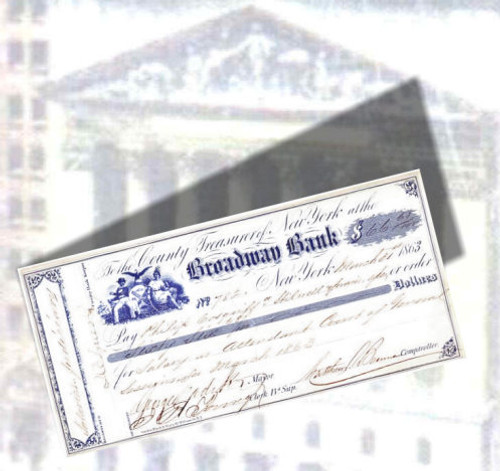
The ealiest extant British cheque is issued |
| This is an order to the London goldsmiths Morris and Clayton to pay a Mr Delboe £
400. |
| p 250-251 |
|
| c. 1660 |
Goldsmiths' receipts become banknotes |
| Because goldsmiths' notes are accepted as evidence of ability to pay they are a
convenient alternative to handling coins or bullion. The realisation by goldsmiths that
borrowers would find them just as convenient as depositors marks the start of the use of
banknotes in England. |
| p 251 |
|
| 1661 |
Bank of Sweden issues notes |
| It becomes the first chartered bank in Europe to do so. |
| p 552 |
|
| 1661 |
Wampum ceases to be legal tender in New England |
| However it continues to be used as currency in other parts of America for another 200
years. |
| p 40 |
|
| 1663 |
First British Guineas produced |
| This is a new milled coin, initially worth £1, using gold from west Africa, hence the
name guinea. |
| p 242,244 |
|
| 1664 |
Construction of the New York citadel paid for in wampum |
| Stuyvesant arranges a loan worth over 5,000 Dutch gilders in wampum to pay the wages
of workers constructing the citadel. |
| p 40,458 |
|
| 1666 |
Act for the Encouragement of Coinage |
| English mint charges are abolished and replaced by import duties on wine, beer, cider,
spirits and vinegar. |
| p 243 |
|
| 1668 |
Pepys refers to banknotes in his diary |
| In his entry for 29 February he mentions sending his father a note for £600 issued by
a goldsmith. |
| p 251 |
|
| 1672 |
First state issues of copper coinage in England |
| There had been occasional licensed issues by private minters since 1613. The
attractive new, milled coinage with the image of Britannia, tends to disappear from
circulation, in accordance with Gresham's law, though not as quickly as the new silver
coins do, while the existing badly worn, unattractive hammered coins and tokens continue
to be used. |
| p 243 |
|
| 1672 |
Charles II introduces the Stop of the Exchequer |
| The goldsmiths refuse to lend more money to the king who has already borrowed huge
sums and therefore he prohibits most payments from the exchequer, initially for a year and
later indefinitely. In the late 1670s and the 1680s several of his largest creditors go
bankrupt. |
| p 251-254 |
|
| 1681 |
First public note-issuing bank founded in Massachusetts |
| In this context the term bank means simply a batch of bills of credit issued
for a temporary period. This example is followed subsequently in other British colonies in
North America. |
| p 461 |
|
| 1682 |
Sir William Petty's Quantulumcunque concerning Money published |
| Petty, a founder of Britain's Royal Society, argues that banking will provide a major
stimulus to the English economy and world trade. |
| p 238 |
|
| 1689-1697 |
War of the League of Augsburg against Louis XIV of France |
| The English government has difficulty in raising enough money for the prosecution of
the war by taxation and borrowing from the goldsmiths. |
| p 256,258 |
|
| 1690 |
The Massachusetts Bay Colony issues official paper money |
| These notes are used to pay soldiers returning from an expedition to Quebec. They can
be used to pay taxes and are accepted as legal tender. Other colonies subsequently copy
the example of Massachusetts. |
| p 460-461 |
|
| 1693 |
The English Parliament passes the Tontine Act |
| This act, based on the ideas of the Italian adviser to the French court, Lorenzo
Tonti, marks the beginning of the English national debt. The tontine is a scheme
for raising money on a long-term basis by weighting rewards in favour of the longest
lasting contributors. |
| p 263 |
|
| 1694 |
Bank of England is founded |
| The main purpose of the Act founding the Bank is to raise money for the War of the
League of Augsburg by taxation and by the novel device of a permanent loan on which
interest would be paid but the principal would not be repaid. |
| p 238,258-262 |
|
| 1695 |
Bank of Scotland is founded |
| The first joint-stock bank in Europe solely dependent on private capital and wholly
unconnected with the state. |
| p 238, 272-273 |
|
| 1696 |
The Million or Lottery Act |
| The English government attempts to raise £1 million by issuing 100,000 shares of £10
at 10% with the possibility of sharing a total of £40,000 to be put up each year as
lottery prizes. The target is not reached and the money is used as subscriptions to the
capital of the Million Bank which becomes an investment fund for government securities. |
| p 260,263-264 |
|
| 1696 |
The Great Recoinage |
| England's silver coins, many of which are worn or clipped, are replaced by new,
full-weight silver coins. |
| p 244-246 |
|
| 1696 |
The Ingrafting of the Tallies |
| Following the failure of the attempt to create a National Land Bank, which damages
confidence in financial institutions, and a shortage of cash caused by the Great
Recoinage, there is a collapse in the value of government tallies. The Bank of England
helps the government out by taking up most of the tallies which are ingrafted into
the Bank's capital stock. In return the Treasury agrees to pay 8% interest on the tallies.
|
| p 261 |
|
| 1698 |
Coins form less than half the English money supply |
| Davenant, a contemporary writer, estimates that the total value of coins in
circulation is less than that of tallies, bills, banknotes etc. Increasingly the power of
money creation is passing from the King, in charge of the mint, to the London money market
and provincial banks. Political and constitutional power is also affected by this transfer
of financial power. |
| p 278-281 |
|
| 1699-1727 |
Sir Isaac Newton is Master of the Mint |
| During Newton's period in charge the emphasis of the mint's work changes from coining
silver to coining gold. |
| p 247 |
|